Oilfield & Solar Sites
Metal Buildings for Remote Energy Sites
Field offices, control rooms, maintenance shops and pump houses for energy operators, built where there is no water tap, no power drop and no supply house down the road. We have delivered four of them across the Permian Basin, and we are ISNetworld A-rated before you ask.
Site Conditions
What Changes When the Site Is Remote
The steel is the same steel. What is different is everything a town lot gives you for free, and each of those has to be somebody's scope before the first column goes up.
The Pad
No finished lot, no curb, no storm sewer. Grading, drainage and a compacted caliche pad come first, and on our Permian builds they came under the same contract as the building so the foundation crew was not waiting on someone else's dirt work.
Water
There is no municipal tap. Every one of our Permian O&M facilities has a separate exterior pump house for water, built as part of the job rather than left for the operator to solve after move-in.
Power
Utility service can trail the building by months. We coordinate with your electrical scope, and generators can come through our sister company UTS ElectricPros, an authorized Cummins dealer, so the building and its power are planned together.
Wind Exposure
Open range is a different wind design from a lot in town. Wind speed and exposure category are taken from ASCE 7 for the actual site, and the metal building engineer designs to those numbers, not a regional average.
Heat and Concrete
Summer placement in West Texas shortens every concrete window. Our General Manager has completed American Concrete Institute programs in concrete construction and materials, including hot-weather concreting, and runs placement, jointing and curing to the specification.
Distance
Every return trip is hours, not minutes. Foundation, erection, fit-out and site work under one contract means one crew plan and no gaps between trades for you to manage from far away.
Completed Work
Four Permian Builds, Three Operators
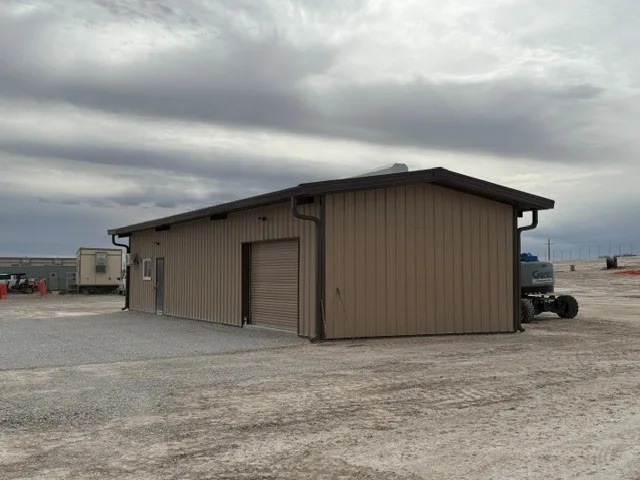
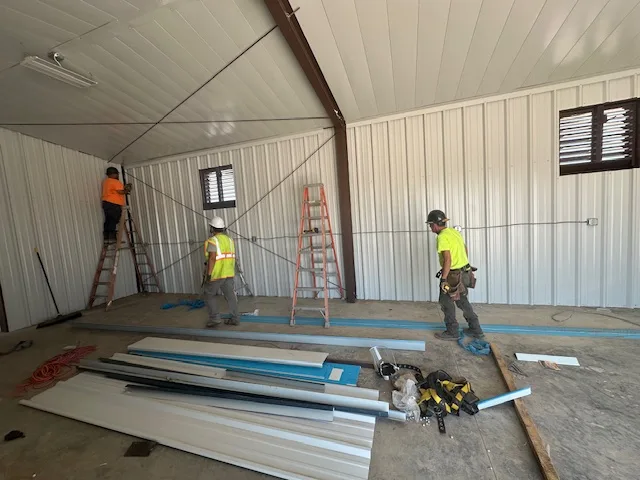
South of Midland for WHC Energy Services on a Chevron project. Two locations in Culberson County for Delaware Ranch Solar. One for Greater Bryant Solar in Midland County. The same operations and maintenance floor plan each time: a full SCADA room, two offices, a restroom, maintenance bays and a standing-seam roof, with a separate pump house, on a caliche pad with the site work included.
These are staffed working buildings on remote ground, which is the hard version of the job. The full story, with all four photographs, is on our energy and O&M facilities page.
What We Build
Buildings Operators Need in the Field
- Field offices and control rooms, including SCADA rooms
- Maintenance shops and bays
- Pump houses and utility buildings
- Parts and equipment storage
- Staffed operations buildings with offices and restrooms
- The same plan repeated across several sites
Standing-seam roofs are installed under our General Manager's MBCI installer certification, which MBCI requires for its Standard III and Single Source weathertightness warranties.
Prequalification
The Numbers Your Contractor Portal Asks For
- ISNetworld
- A-rated
- EMR
- Below 1.0
- Field supervisors
- OSHA 30-Hour
- General liability
- $2M / $4M
- Single-project bonding
- $10,000,000
- Aggregate program
- $25,000,000+
Common Questions
Remote-Site Questions
- Do you build on remote oilfield and solar sites?
- Yes. Our recent metal building work has been operations and maintenance facilities on remote energy sites in the Permian Basin: south of Midland for WHC Energy Services on a Chevron project, two locations in Culberson County for Delaware Ranch Solar, and one for Greater Bryant Solar in Midland County. Each was delivered turnkey on a caliche pad, with the site work, a separate pump house for water, a full SCADA room, offices, a restroom and maintenance bays under one contract.
- Are you prequalified through ISNetworld?
- Yes. UTS BuildPros is ISNetworld A-rated through the UTS, LLC account, with an EMR below 1.0 and OSHA 30-Hour trained field supervisors. General liability is $2,000,000 per occurrence and $4,000,000 aggregate, with single-project bonding to $10,000,000 and an aggregate program above $25,000,000.
- Who handles the pad, the water and the power on a remote site?
- The pad and the water are in our scope: grading, the caliche pad, site work and a separate pump house were part of every Permian build. For power, we coordinate with the operator's electrical scope, and standby or prime generators can be sized and supplied through our sister company UTS ElectricPros, an authorized Cummins generator dealer in the same UTS, LLC group, so the building and its generator are not two unrelated contracts.
- How is wind load set for a building on open West Texas ground?
- From the site, not the region. Design wind speed comes from ASCE 7 for the exact location, and on open, flat ground the exposure category often matters as much as the speed itself. We have the metal building engineer design to the site's own values rather than a regional figure, because a building that is fine in town can be under-designed two miles out on open range.
- Where do you work?
- Across Texas, Oklahoma and Arkansas from our office in Richardson, Texas, with completed remote-site work in Midland and Culberson Counties. A site without a published page is not a site we will not go to; tell us the location and the window.
Choosing a contractor for a remote site? Six questions to ask before you award the job.
Building Somewhere Hard to Reach?
Tell us the location, what the building has to do, and what is already on site: pad, water, power. You get a scope that says who owns each of them before anyone mobilizes.