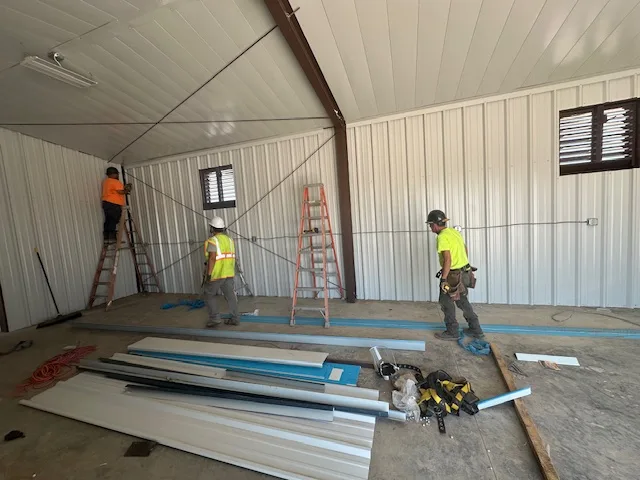
Most of the buildings energy operators need in the field are not complicated. A field office, a control room, a maintenance shop, a pump house. The steel is the same steel we put up in town.
What makes remote-site work go wrong is almost never the building. It is the gaps around it: the pad nobody priced, the water nobody planned, the power that arrives three months after the keys, the wind design taken from a regional chart. Every one of those is somebody's scope, and if the contract does not say whose, it becomes the operator's problem on a site that is hours from anywhere.
We have built four operations and maintenance facilities across the Permian Basin for three operators, each with a full SCADA room, offices, maintenance bays and a separate pump house on a caliche pad. These are the six questions I would ask any contractor, including us, before awarding a building on a remote site.
1. Who Owns the Pad, the Water and the Power?
Ask for it in writing, line by line. On a town lot, the site hands you a finished grade, a water tap and a power drop. On a remote site you get none of them, and a building quote that starts at the slab has quietly left all three with you.
The pad. Grading, drainage and a compacted caliche pad come before the foundation. If the pad is someone else's contract, the foundation crew waits on their schedule.
The water. There is no municipal tap. Every one of our Permian O&M buildings has a separate exterior pump house, built as part of the job.
The power. Utility service can trail the building by months. Find out whether the contractor is coordinating with your electrical scope, and who is supplying temporary, standby or prime power. In our group, generators come through our sister company, UTS ElectricPros, an authorized Cummins generator dealer, so the building and its power are planned together rather than bought separately.
A contractor who cannot tell you who owns each of those three has not thought about your site yet.
2. What Are Your Prequalification Numbers?
If your company prequalifies contractors, you already know the portal. Ask for the numbers before the bid rather than after the award, and check them against the source:
ISNetworld grade. Not just membership. UTS BuildPros is ISNetworld A-rated through the UTS, LLC account.
EMR. The experience modification rate is the insurer's own measure of a contractor's injury history against its peers. Ours is below 1.0.
Supervisor training. Our field supervisors are OSHA 30-Hour trained.
Insurance and bonding. We carry general liability of $2,000,000 per occurrence and $4,000,000 aggregate, with single-project bonding to $10,000,000 and an aggregate program above $25,000,000.
A contractor who hesitates on any of these is telling you something.
3. Is the Wind Design for This Site or for the Region?
Open West Texas ground is not the same wind environment as a lot in Midland. Design wind speed comes from ASCE 7 for the exact location, which anyone can check on the ASCE Hazard Tool, and on flat, open terrain the exposure category often matters as much as the speed.
Ask what values the metal building engineer is designing to and where they came from. The right answer names the site. A regional figure is how a building that would be fine in town ends up under-designed on open range.
4. How Will You Place and Cure Concrete in the Heat?
Most Permian concrete goes in during weather that works against it. Hot weather shortens the time to place and finish, shortens the window to saw control joints before the slab cracks on its own, and makes curing the difference between the strength the engineer designed and the strength you get.
Ask who on the contractor's side reads the mix submittal against the specification, who decides when joints are cut, and who reviews the test results as they come in. On our jobs that is our General Manager, who has completed the American Concrete Institute's certificate programs in concrete construction and in concrete materials. The engineer still designs the slab and an independent lab still tests it; the point is that someone on the builder's side understands both.
5. How Many Trades, and How Many Trips?
On a remote site, every return trip costs hours and every handoff between contractors is a gap you manage from far away. Ask how the work is split. Foundation, erection, interior fit-out and site work under one contract means one crew plan and one party accountable for the sequence.
Ask as well how the contractor plans deliveries. A missing part in town is a trip to the supply house. On a remote site it can be a lost day for the whole crew.
6. Have You Built This Building Before?
If you need the same facility at more than one location, this is the question that matters most. The second building is where multi-site programs gain or lose money: a contractor who has built your plan already has the engineering resolved, the submittals approved, the long-lead items known and a crew that knows the sequence. A contractor building it for the first time solves all of that again, at your expense, and site four ends up different from site one.
We have built the same O&M floor plan four times, for WHC Energy Services on a Chevron project south of Midland, twice for Delaware Ranch Solar in Culberson County, and for Greater Bryant Solar in Midland County. The details are on our energy and O&M facilities page.
Where We Fit
UTS BuildPros builds field offices, control rooms, maintenance shops and pump houses for energy operators across Texas, Oklahoma and Arkansas, with the pad, the water and the site work in scope. More on how we approach remote sites is on our oilfield and remote-site buildings page.
If you are planning a building somewhere hard to reach, send us the location, what the building has to do, and what is already on site. You will get a scope that says who owns the pad, the water and the power before anyone mobilizes.